Custom Beef Costs: A Real Example
A Real World, Comprehensive Dive Into Beef Expenses and Value
Introduction
Foregoing the weekly trip to the store for beef has become more popular as consumers increasingly work directly with producers for their meat.
The Pasture-to-Plate era is in full effect.
The question arises, is that decision worth it?
This article covers all aspects related to that very question using actual measurements, costs, and comparative pricing head-to-head with a large retail grocery chain.
1. Purchase Price of a Whole Beef
Brace yourself…you are about to get hit hard with some sticker shock.
How does a beef bill consisting of $3,217.34 sound?
That cost happens to come with 412 pounds of beef.
Okay now, how does that exact same beef order sound at an even larger price of $4,036.92?
The comparison above outlines the difference between a whole custom beef and the equivalent cuts if you retrieved them from your local Walmart and bought the total 412 pounds over time, respectively.
That lump in your throat you feel from the price tag(s) is understandable.
Afterall, we recognize that it is a lot of money to pay!
However, with producers like us around, you will find many ranchers work hard to provide quality meat at a lower cost that beats, or is at least competitive with, the larger chain retail stores while maintaining high standards.
The initial and most significant cost is always the price of the animal itself. This is typically quoted as a rail weight price per pound (the weight of the carcass after being slaughtered and dressed but before being cut into packaged, retail cuts).
In recent years, rail weight prices can range from $4.00 to $6.00 per pound, though this varies by region, breed, and farm practices.
For some background, our fall 2025 beef customers were charged $4.69 per pound of rail weight.
2. What Costs are Included?
The costs included depend upon your producer.
Not every farmer or rancher rolls the costs of kill fees, disposal fees, butcher fees and delivery fees into one bill. Usually, those are added onto the basic price found in the standard rail weight.
We happen to be some of the few that do roll those fees into our $4.69 per pound cost for the rail weight.
The point is not to necessarily search out producers that consolidate the price for you. Rather, you need to understand where all the costs originate and allocate, or budget, your expenses to the best product you desire.
Remember, knowledge is power.
3. What Costs are NOT Included?
A few items that often are not covered by the producer’s price tag are single-steak packaging, pre-formed patties, offal (this is organ meat like heart, liver, tongue, oxtail, etc.), and anything else you request that strays beyond the basic burger packaging and steak cuts.
This means, if you order your burger to be made into patties instead of stored in a typical one- to two-pound frozen package, you will accrue additional costs.
Further, some overlook the initial costs of freezers. Even if you have a freezer, the next question is whether it has sufficient room to store the additional amount of food you will receive for your order.
For example, the 412 pounds that came from our whole beef for 2025 was measured at approximately 20 cubic feet of space, which did not include the offal we requested (heart, oxtail, and tongue).
Moreover, in addition to wild game, one whole hog order, and other miscellaneous frozen foods, we rely on two freezers in total to store our items.
4. Meat Details
Below is a consolidated list of the meat packages we received by type, amount, weight, and the total percentage of our overall beef cut order.
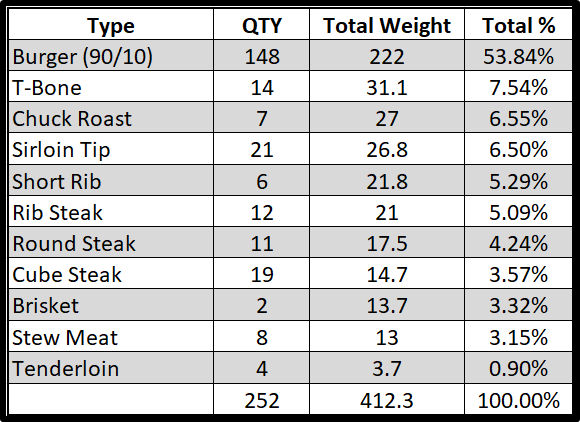
That is a lot of empirical data to throw at someone, right?
We get it, but this is important to comprehend because now we need to break down the information in relation to cost and something consumable, more store appropriate to develop an adequate comparison.
Before we dive in, let us address some items to highlight.
Notice that the overall burger amount is slightly more than half of the order. That is because it includes trimmings from other steak cuts, small excess amounts that are useless for other cuts, or overall tougher meat which is easier to consume in burger form.
Looking at the opposite end of the spectrum, we have tenderloins that are less than one percent of the order’s totality. Unfortunately, that is basic biology, and we cannot produce more or bigger tenderloins.
The physical size of the butcher animal is the greatest limitation to specific cuts, simple as that.
The Overall Cost Calculation
Remember, our cost was $4.69 per pound of rail weight.
Our rail weight (hanging carcass) was measured at 686 pounds upon slaughter.
$4.69 x 686 pounds = $3,217.34
We had no add-on charges, so the overall cost of $3,217.34 did not change.
The Cost Per Packaged Pound Calculation
However, that price was for a hanging carcass on a butcher rail. It was not cut into consumable burger packages and wrapped steaks.
When you break down the total cost of $3,217.34 into the 412.3 pounds of cut and wrapped meat, you find the cost per pound increases to $7.80 per pound.
$3,217.34 ÷ 412.3 pounds = $7.80
Why The Weight Reduction?
As an aside, our carcass weight reduced by 273.7 pounds from the 686-pound rail weight to produce 412.3 pounds of packaged meat.
Some may ask, why the reduction in weight?
Even though the hide, head, and entrails are removed upon slaughter, there are still sizeable pieces of bone left within the rail carcass in addition to some minimal moisture shrinkage during the typical 14-to-21-day aging process prior to cutting.
When the butcher removes femurs, spinal columns, pelvic bones, and large shoulder blades you incidentally lose additional weight. This is all unconsumable weight.
5. Customer Averages
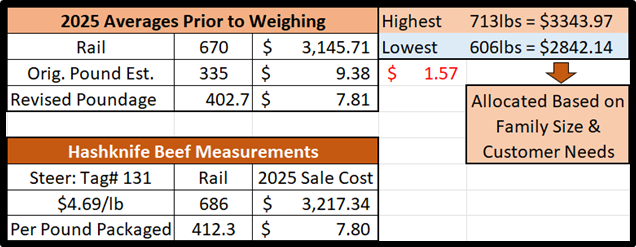
We sold ten total butcher steers to customers in the fall of 2025. Using those metrics in addition to our personal eleventh butcher animal, we were able to collect some valuable metrics.
On average, our customer carcass weights measured 670 pounds for a grand total cost of $3,145.71.
Our smallest carcass weight was 606 pounds for a total of $2,842.14 and our highest carcass weight was 713 pounds for a total of $3,343.97.
In years past, we used the easy 50% rule as a general measurement for estimating the packaged weight of the butcher animal compared to the rail weight for cost calculation. Due to our inability to store customer orders and the requirement to quickly deliver them to the respective owners, we have never weighed previous beef package totals.
Using our own meat order this year which had an identical finishing to our customers, we had the perfect opportunity to weigh our own. This opportunity resulted in the burger and steak data outlined above.
Because of the updated calculations using hard data, we were forced to revise our 50% estimation appropriately.
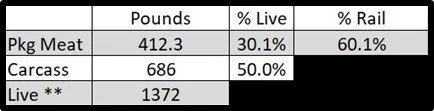
**Estimate Based on Live weight as double the Rail weight
Previously we took the 670-pound average customer carcass weight measurement and halved it, which resulted in our 335-pound estimate.
This easy estimate calculated an average cost of $3,145.71 for 335 pounds of packaged meat, the final price per pound of steak and/or burger resulted in $9.38.
However, after obtaining more accurate measurements we found the packaged results were just over 60% of the carcass weight, not 50%.
That increased take-home average from the 670-pound carcass weight measurement increased to 402.7 pounds in customers’ freezers. Therefore, the average cost of $3,145.71 for an additional 67.7 pounds taken home reduced the overall final price per pound of steak and/or burger to $7.81.
Because of previous estimates, we over calculated cost per pound by $1.57, which was great to discover!
That meant more meat was taken home to people to feed their families at a lower overall cost per pound!
Final Note: For our customers, we allocate livestock based on family size and customer needs. For instance, if we have two families that order a whole beef each, we will oftentimes assign the biggest steer to the biggest family. This way, if we have over a one-hundred-pound discrepancy like this year from the heaviest compared to the lightest, we can help support a five-person family a little more appropriately compared to a three-person family.
6. Our Beef Measurements
Shown above, our own beef measured 686 pounds rail weight, so it was a bit heavier than the average across the butcher herd.
Recall from earlier that after calculations our beef cost $7.80 per pound of packaged meat. We use this calculation to determine the cost of each cut by its corresponding poundage below.
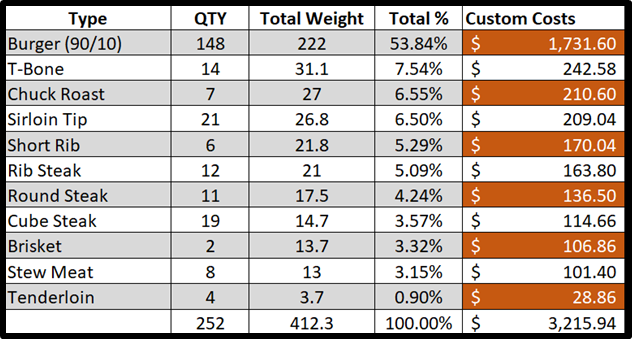
Comparison Note: As a matter of pride and a good way to test our own product, we always eat the same meat we provide customers.
However, when we receive tips or suggestions related to different finishing feeds, alternate finishing durations, butchering flavor based on age and sex of the animal, we always test ourselves first. This same principle applies to butchers as well. The only exception to the processor rule is if we receive a strong request from a customer to go to a specific butcher due to their own personal experiences. In that case, we waive the need to try the butcher personally for that individual. Otherwise, we always make sure to test ourselves before we allow our final product to be influenced by other variables.
Due to this, the last time we received a similar order to our customers was before we started our YouTube channel and this blog. Therefore, the fall of 2025 was the first opportunity for us to test, measure, and weigh a similar customer product to provide data-driven analysis.
7. Retail Comparison
Now, to extrapolate the same exact cuts by their appropriate weight to the prices found per pound at a large chain retail store: Walmart.
Remember the meat breakdown outlined above? When bought as custom, each pound of meat regardless of whether it was burger or any other steak cut cost $7.80 per pound.
That means while packaged burger costs $7.80 per pound, the same applies to tenderloins, ribeyes, and every other steak! $7.80 per pound across the board, regardless.
When this was written in late December of 2025, we used the cheapest prices we could obtain from Walmart.
Below is the extrapolated information of each cut of meat, with total poundage, cost per pound custom with correlated total custom cost, then continued forward with cost per pound retail and its correlated final retail cost.
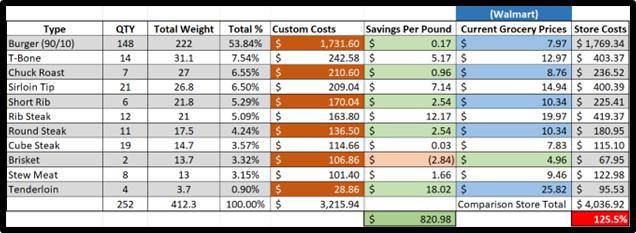
The key highlights to take away from the graph above are the savings cost, total cost comparison, and percent increase in retail over custom costs. Keep in mind 100% would mean equal pricing to the custom order.
On the left side of the graph, you observe the same information as shown previously but now calculated across to a comparison of retail meat prices with a custom cost savings between the two totals.
Notice 90/10 burger custom at $7.80 per pound resulted in $1,731.60 total compared to Walmart’s $7.97 per pound cost totaling $1,769.34. The savings per pound to buy custom rather than retail was 17 cents per pound for an increased payment in store of $37.74 across the 222 pounds of burger.
Using that information and moving down the chart, only one cut bought via retail was cheaper than custom beef: brisket.
Bear in mind brisket used to be considered a ‘throwaway’ cut and not saved, meaning it simply became hamburger. The popularity of smoking meat as a preparation technique has changed its popularity for a growing segment of consumers nationwide.
As the totals are compared and combined, you notice that a final $820.98 is saved by purchasing a whole custom beef rather than obtaining the same cuts through retail outlets.
The retail total ended at 125% in direct financial comparison of the custom total. Therefore, by purchasing the same amount of meat by the exact same cuts from a retail chain, consumers pay 25.5% more annually.
8. Counter Arguments and Concerns
Some consumers like to play Devil’s Advocate and outline issues which are reasonable and warranted. However, we believe the potential disadvantages of buying via retail outlets are outweighed immensely by the guaranteed benefits of direct purchases.
Not all cuts are wanted, desired, or included in the complete package received.
That is absolutely correct, no question. For example, you have ribeye steaks but because of that there is no rib roast for that holiday prime rib. Or another example is the lack of New York strips because you have retained that cut within the T-bone steaks.
Despite that, with a custom beef like the one illustrated above, you can supplement your freezer with some of those special cuts using the $800 saved by purchasing directly from a producer. Ultimately, you can maximize the usage of your grocery money to get some of those extra special pieces of meat.
A custom beef clearly has a finite number of certain steaks. However, you are still able to receive a rounded supply of steaks overall. Further, if you use your savings from buying custom you can now buy supplemental meats for special occasions or if your stockpile eventually runs low.
Not all retail costs are like this comparison.
Yes and no.
Keep in mind this information was gathered in December 2025. That was a year where beef prices were extremely higher than usual due to a lower national slaughter herd in the United States.
Like fuel prices, though, it is highly unlikely that beef prices will reduce much, if at all, even in good years moving forward. Once the consumers have accepted the new norm in prices it is difficult for retailers to let that easy profit margin go.
Now, the information gathered from Walmart may not be completely accurate to other retailers. It was chosen as the retailer to compare against simply because it tends to be accessible nationwide and often resides toward the lower end of pricing, although not always.
Some local butcher shops may beat the prices, maybe not, but Walmart was an easy go-to comparison for most consumers in the United States.
With that stated, the retail costs were the lowest prices found within the Walmart inventory. That means that any moderate or higher prices were not accepted for a comparison and the retail prices hold a higher potential for an even bigger bill!
For example, we used 90/10 burger comparison costs. You can find 80/20 for cheaper, you can also find other variations of 90/10 and 93/7 for much higher prices. We maintained the integrity of the comparison with the same burger lean/tallow ratio and used the cheapest price possibly found.
Therefore, yes, some retail prices may be cheaper, but it is highly unlikely for the exact same type of meat cuts and corresponding quality.
Retail store meats are already pre-packaged.
Stores do package meat, but those items are all done individually and are not freezer ready.
Typically, retail meat is found in some version of a plastic or Styrofoam tray, then wrapped in clear plastic wrap. That configuration of packaging will not adequately protect your meat long-term in the freezer.
Instead, it needs to be wrapped in plastic to remove air, then packaged in heavy freezer paper to ward off ‘freezer burn’ and keep moisture away from the meat. Retail stores do not prepare beef this way in any viably large quantities. If this is packaged by your local retailer, you are fortunate enough to have a great customer service-oriented store in your area.
Most custom beef purchases are MORE expensive than retail.
At the end of the day, with likely add-ons, all the meat packaged, then froze, and boxed for delivery, yes, that concern is commonly true.
In recent years, typical custom packaged beef is priced in the range of $10.00 to $12.00 per pound. There are some below that price span and others above it due to common factors of operating margins, breed, region, production capabilities, etc.
We found the break-even point where our beef equates as close to retail meat as possible, financially speaking, is the $9.79 mark.
As a quick reference, that is $1.99 higher than our actual packaged cost per pound.
Now to evaluate and break down the two hypothetical, commonly referenced, custom prices above.
$10.00 Per Packaged Pound?
Even at $10.00 per pound, you still result in a $4,123.00 custom beef total. That is a higher amount than retail by a total of $86.08. At this point you ask, is the price worth it?
That answer depends on whether you value convenience in comparison to supporting local producers, guaranteeing quality meal ingredients, and you know the circumstances surrounding the production of your meat.
Accurate labels are increasingly important to consumers.
Those items include things such as hormone free, all-natural, pasture raised, and other clear requirements to ensure consumer health. Those are all vital factors to the ultimate buying decision you develop when providing for your family.
Much of the time, you can guarantee the authenticity of those labels by buying directly from producers. So, perhaps, the $86.08 additional charge is worth it for peace of mind.
$12.00 Per Packaged Pound?
Continuing the hypothetical cost increase to $12.00 per pound, you result in $4,947.60. Now, that is a higher amount than retail by a total of $910.68!
Again, you are now choosing to purchase based on known facts about a quality product, but you may understandably hesitate to commit to a full order of beef due to the significant bill increase.
That is where it may be beneficial to consider purchasing smaller quantities like a half or a quarter, if the producer is able to support those smaller requests.
Conclusion
Custom beef orders are more popular as retail costs continue to skyrocket.
However, hopefully using our pricing breakdown, cost illustrations with what is included and not in each order, listing the meat cuts within a full order, then showing customer averages across eleven head, and finally comparing retail prices to our specific associated cost of $7.80 per pound it provides better insight.
Finally, some common concerns do push customers to reconsider custom beef orders. We believe we appropriately addressed those to provide the best informative insight for consumers to consider moving forward.
The most important thing is that you make whatever your decision is using facts and the best possible understanding of nuances and intricacies as possible. Look into the information and do what is best for you and your family!
